

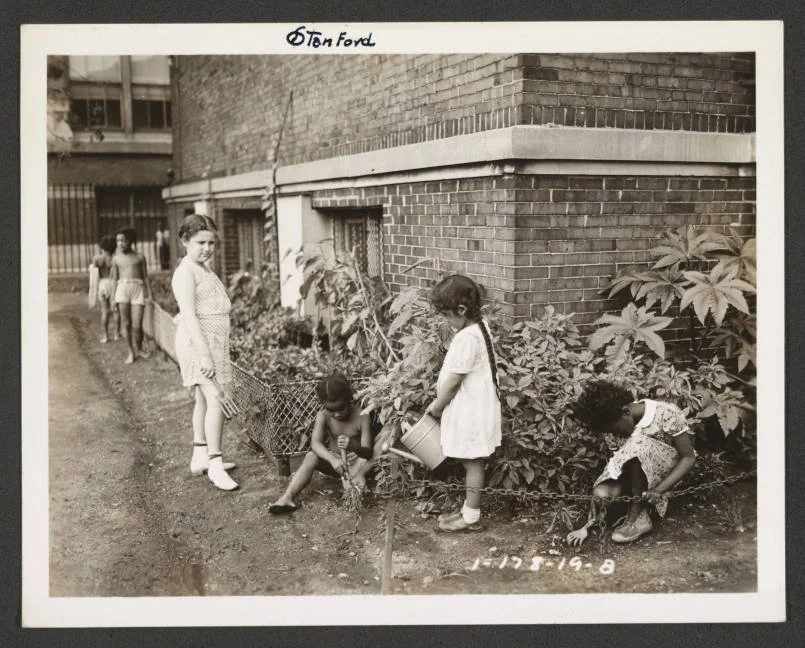
Stanford Park Junior Garden Club, 1937. The Chicago Park District Archives, Chicago Public Library.
Johnson Publishing Co. and the Chicago Park District.
It’s fair to say that I’m comfortable with volume. As an archivist, my sweet spot is large photography collections, especially the archives of storied career photographers and institutional archives. My formative years were spent managing the Prints & Photographs collection at the Chicago History Museum, which at the time comprised about two million unique objects: photographic prints of every vintage, negatives, lantern slides, cased images, photomechanical prints, broadsides and more. Years later, I freelanced for the late, great photographer Steve Schapiro, bringing order to an archive spanning some fifty years of work as a photojournalist and movie stills photographer.
In 2012, my company was tapped to work on the Johnson Publishing Company (JPC) archive, a collection of nearly 4 million prints, negatives, and slides that comprises perhaps the most significant record of African American life in the 20th century. The work came at a pivotal moment for the JPC, which was preparing to move from its landmark building at 820 S. Michigan Avenue to smaller offices nearby. On a tight deadline, our objectives were to restore order to the archive (which had been without a full-time librarian for many years), create a basic inventory, rehouse the collection, and move it to its new home. We worked with contracted architects to design a temperature-controlled, accessible storage room for the collection.*
Similarly, in 2015, the Chicago Park District was preparing to transfer its records to the Special Collections Department at the Chicago Public Library (CPL). CPL asked us to assist with arranging and rehousing the collection in advance of digitization and transfer. The collection included photographic material dating back to the establishment of a single citywide district in the 1930s, as well as print materials from the 1910s and 1920s.
The archive was generally arranged into series by park name but lacked consistent descriptive terminology. Developing standards that accorded with Library of Congress subject headings became our first challenge, which we tackled in concert with CPL staff. After that, the arrangement and rehousing fell into place. In all, work on this 100-linear-foot collection - the Chicago Park District Archives - took many months of intense effort. It’s now not only one of my favorite past projects but also one of my go-to resources for neighborhood history!
* Sadly, the Johnson Publishing Company was forced to move out of its new space shortly thereafter, and the collection was boxed and moved to basement storage. It remained there until 2019, when a consortium led by the Smithsonian acquired it. The collection is now the subject of a years-long effort to catalog, digitize, and preserve it.
