

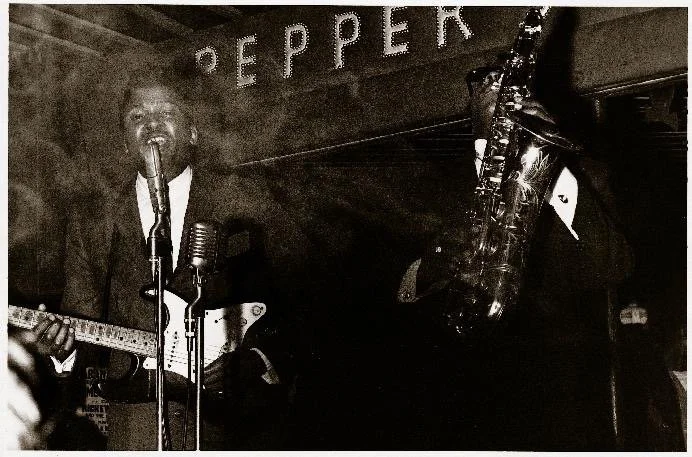
Otis Rush and Little Bobby perform at Pepper’s Lounge, 1963. The Rayburn Flerlage collection, Courtesy, Chicago History Museum.
< Chicago Mobsters. Courtroom drawing by Andy Austin. Pritzker School of Law, Northwestern University.
Long term planning for sizable collections.
Sizable collections, such as the archives of professional photographers or organizations, often require an archival appraisal before they are transferred to a cultural institution. Not to be confused with a monetary appraisal or valuation, an archival appraisal gathers the information a museum needs to judge whether an acquisition fits its mission. It typically includes a description of the archive as a whole, an inventory, notes on scope and content, measurement by volume, a description of material types and condition, and biographical information.
A well-written appraisal equips an institution to decide whether to acquire a collection and, when a sale is involved, can serve as the foundation for a later monetary valuation. Because monetary valuations tend to be costly, I advise clients to begin with a straightforward archival appraisal unless their ultimate goal is a sale on the open market.
Archival Image has prepared appraisals for individuals and estates, which clients then use in negotiations as they shop a collection around for a new home. A prominent example is the Raeburn Flerlage collection, which I appraised for the photographer’s estate and which was later acquired by the Chicago History Museum.
We also appraise collections for organizations considering a large acquisition. Here, the appraisal helps the organization budget for the work that follows, such as archival processing, digitization, or conservation. One especially interesting example is the Andy Austin collection of courtroom drawings, which we appraised on behalf of the law library at Northwestern University’s Pritzker School of Law.
When an estate holds a collection that has already drawn interest from several institutions, I can also serve as an advisor to the executor, helping to review and respond to proposals. Finding the right home for a large collection means weighing an institution’s resources as well as how closely its mission reflects the creator’s philosophy and intent.
